
Last updated: November 2026
Estimated reading time: 10 minutes
A B2B case study is one of the most impactful content pieces you could possibly create, in my opinion. It’s proof, backed up by a real customer, that you can actually do what you claim to do.
There’s a problem with case studies, though. A lot of them are, well, a bit dull and don’t do the project justice. They read like a stiff press release, often with the results buried deep in the text, and readers are left none the wiser about whether you could actually help them solve the problems they’re having.
This guide is about how to write a case study that wins you customers. The kind a prospect reads and thinks, “I want that too – I need to book a demo!”
Key takeaways
A B2B case study is proof from a customer that you can do what you claim, and that’s what turns a cautious prospect into a buyer.
They prove what you deliver, give your sales team something to send, boost your SEO and AI search visibility and are easy to repurpose into social, email and web content.
B2B case study structure template: key results, introduction, problem, solution, results and expansion.
Lead with a specific, numbers-led result. “[Company] reduces invoicing costs by 75%” makes it tangible.
The best case studies start with in-depth customer interviews, so do your prep, ask open questions and record the call.
Keep the customer the focus, stay away from jargon and make the case study easy to skim.
Why case studies convert prospects into customers
B2B buyers are willing to spend money on new products, services and tools, but they need to be confident in your company’s abilities before they commit. Here’s what a strong case study does:
They’re evidence you deliver
Anyone can declare they’re good at X, Y and Z on their homepage. A case study with a named customer and a tangible result is evidence of those claims. It answers the prospect's question, “has this supplier solved the problem we’re having before?” before they book a demo.
They’re a valuable resource for the sales team
The sales team hears a lot of the same questions, usually variations of: “Do you have proof your product/service works for a company like mine?” A relevant case study answers the question on the spot, with a named customer and tangible results to back it up. It gives the sales team something to send after a discovery call, add to a proposal or use to re-engage a prospect who has gone quiet.
They give you an SEO and AI search boost
When buyers get serious about choosing a provider, they tend to search for something specific like “e-invoicing software for [insert industry here] companies”. A case study about how e-invoicing software helped your customer in that industry matches those searches closely. It describes customers’ problems in the language they use. The keyword search volume might not be high, but those who do search it are further down the buying funnel.
AI tools work in a very similar way. Ask Claude or ChatGPT to recommend a company that offers e-invoicing software and, among other sources, it’ll pull from your case study pages. “We helped [insert client here] achieve [insert result here]” is the very kind of information AI tools will pull from.
They’re easy to repurpose into other content
One great case study is the gateway to more great content. The key results become a LinkedIn post, the best quote goes on a landing page on your website, and the before-and-after stats become a slide in your sales presentations.
How to structure a B2B case study: Template
Now, let’s get to the reason you’re here – you want to know how to write a really great case study that brings in leads. In my experience, a case study that converts is made up of the following sections:
Key results
This is the summary box that sits at the very start of the case study, before you get into the juicy details. Three or four standout figures or outcomes grab the readers’ attention, encouraging them to find out more. Think “reduced paper invoices by 75%” or "annual recurring revenue (ARR) grew by 30%”. Prospects are busy – get to the point quickly.
Introduction
This is where you give context. Who is the customer, what do they do, the customers they serve, where they’re located, that sort of thing. You’re helping the customer work out whether the company is similar to their own, which is what keeps them reading. Two or three sentences here is plenty, as you’ll get into the meat of the case study later.
Problem
This is where you explain what was going badly before you got involved. What was the customer struggling with specifically, and why did it matter to them so much? Be as specific as possible and integrate direct quotes from the customer for credibility.
“They wanted to boost efficiency” or something along those lines is vague and forgettable – “[Company] was printing and posting 100,000 paper invoices a year at a cost of £50,000” demonstrates the scale of the problem.
Solution
Now it’s time to show the reader why you’re so great. But it’s important to remember that the customer should remain the focus. Yes, you helped them, but readers aren’t really interested in reading how great you thought your company was. They just want to know what your customer got out of it. Otherwise they read like thinly disguised ads, and it can feel insincere.
Now, and I must say this or I’ll self-combust, BACK AWAY FROM THE JARGON. What do you mean “bespoke solutions”? These kinds of phrases tell the reader very little. Tell the reader what you did.
Something like “we helped [Company] replace their paper invoicing with automated e-invoicing software, connected to their existing accounting software, which had the finance team sending structured invoices in less than a fortnight.” It paints a picture for the reader of what benefits they’ll get if they choose you.
Results
This is the part readers are going to focus on. Explain exactly what changed, with figures wherever you can get them. Make sure to tie it all back to the problem you described, so the before and after is stark.
Sticking with the invoicing example (I’ve written a lot about invoicing, if you can’t tell), you might decide to write something like: “invoicing costs dropped from £50,000 annually to just £10,000, and the finance team regained three days previously lost to paper invoice admin.” It’s specific and measurable. A direct quote from the customer is essential here, too. Ideally one that captures the difference in their own words.
Expansion
A lot of case studies end with results. But often, there’s more story to tell. Lots of the clients I’ve written case studies for have their engagements with their customers extended. Perhaps the software is rolled out to other departments, contracts are extended, or the customer uses the software for new use cases.
It’s a great section to include because it’s some of the most persuasive proof you’ve got. Your results show you did a good job on one project. An expanding relationship shows the customer trusted you enough to spend more money with you, and that what you gave them kept working as their needs grew and changed. That’s exactly what a cautious prospect wants to see before they commit!
This section doesn’t need to be long. Something like this works just fine: “A year on, [Company] has rolled the platform out to three more teams, who have saved [insert figure here].”
| Section | What it does | Example |
|---|---|---|
| Key results | A summary box at the top with three or four key results, so skimmers get the point straight away. | "Reduced paper invoices by 75%" |
| Introduction | A few sentences max of context on who the customer is, what they do and who they serve, so readers can tell if it's a company like theirs. | A UK accountancy firm serving 250 SME clients |
| Problem | The specific problem before you got involved and why it mattered, backed by customer quotes and figures. | "[Company] was printing and posting 100,000 paper invoices a year at a cost of £50,000." |
| Solution | What you did to fix it, keeping the customer as the focus. | "We replaced their paper invoicing with automated e-invoicing, linked to their existing accounting software." |
| Results | What changed, tied back to the problem so the difference between the before and after is clear, with customer quotes and figures to back it up. | "Invoicing costs dropped from £50,000 to £10,000, and the finance team regained three days which had been lost to invoice admin." |
| Expansion | How the relationship grew after the first project. | "A year on, [Company] rolled the platform out to three more teams." |
Interview your customer
Now you’ve read up on how to structure your case study, you need to get the ball rolling by organising a time to interview your customer.
How to get customers to participate in case studies
The best time to ask is just after a good result, while it’s still fresh in your customer’s mind. Asking too soon means there’s no real substance to build the case study around. Here’s how to get them to agree to participating:
Let them know why you’ve selected them specifically.
Explain what’s in it for them. They get a success story of their own to use, on their website, in a sales presentation or anywhere else they see fit.
Explain that all they need to do is make some time for a quick chat (30 mins to an hour max).
Send them the interview questions upfront so they know what you’re going to ask them.
Tell them that they will have the final say on the draft – nothing will be published without their approval.
Let them know that sensitive information can be left out or written about generally to avoid potential problems down the line.
How to prepare for a case study interview
A successful customer interview starts with prep. Lots of it. Here’s my advice on how to prep thoroughly:
Do your research
They’re your customer, and probably have been for a while if you’ve chosen them for a case study, but that doesn’t mean research goes out of the window. It’s a good idea to look at past sales calls, onboarding notes and any results you have about their specific account. It’ll help you come up with the questions you’ll ask them during the call.
Come up with interview questions
Once you’ve done your research, it’s time to write the interview questions. I like to group mine around the sections the case study will have, so I know I’ll come away with enough detail for each one. A few on the problem, the solution, results and expansion.
Here are the types of questions I tend to ask:
| Focus | Questions to ask |
|---|---|
| Before | What was the situation before you brought us in, and what finally pushed you to solve it? |
| Cost | What was the problem costing you, in time, money or hassle? |
| Getting started | How did you find getting set up? Were you worried about anything, and did it play out? |
| The difference | What's changed since, and can you put a number on it? |
| Day to day | What can you and your team do now that you couldn't before? |
| What's next | Where do you want to take it from here, and what would you say to someone weighing up the same move? |
The questions you choose will depend on who you’re asking, of course. But the ones above are a good jump-off point.
Record the call (with permission!)
Your customer is going to give you a lot to go on, so make sure you’re recording the call. This means you won’t have to think about making notes as they’re talking – you can focus fully on their answers. Make sure to ask their permission first!
Examples of B2B case studies that convert
The best way to learn what makes a truly great case study is to look at examples. Here are two that I find myself coming back to:
Asana x Zoom
Asana’s Zoom case study does a lot of things right:
It leads with the result in the headline, “Zoom saves 133 work weeks per year with Asana.”
It lets the customer do the talking. The whole thing is told through Zoom’s own people, in their own words. Quotes feature heavily.
The numbers are tangible. “Saved 667 work days per year” really puts the benefits of Asana into perspective.
The problem statements are also tangible. It’s not a vague “we were struggling with submitting forms” but “Zoom employees submit nearly 900 forms per month.”
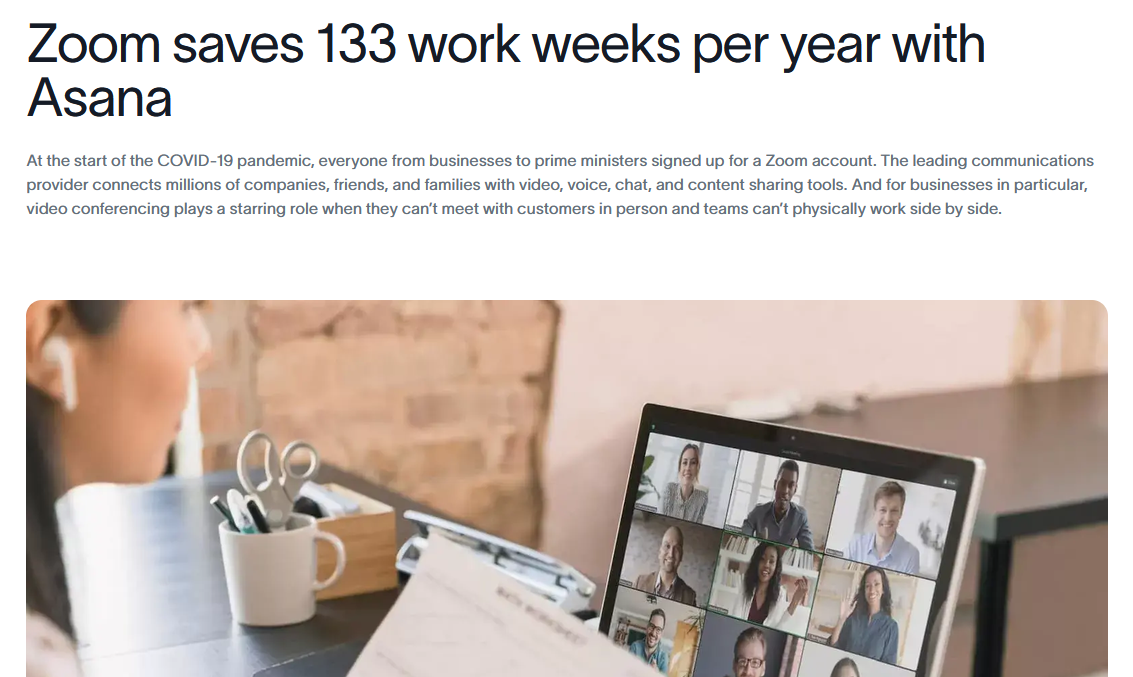
Image source: Asana
HubSpot x Threekit
HubSpot’s Threekit case study is another example to refer back to:
The headline instantly gives the result and the speed. “47% in six weeks” gets readers interested before they’ve even got into the meat of the case study.
Key stats are shown before and after. “17% to 25% brand visibility in six weeks” shows you exactly where Threekit started and ended up. That’s far more convincing than a single percentage, in my opinion.
It’s built for skimmers. There’s a short summary at the top, a quote that includes key numbers, and the headings that feature the main stats readers need to know.
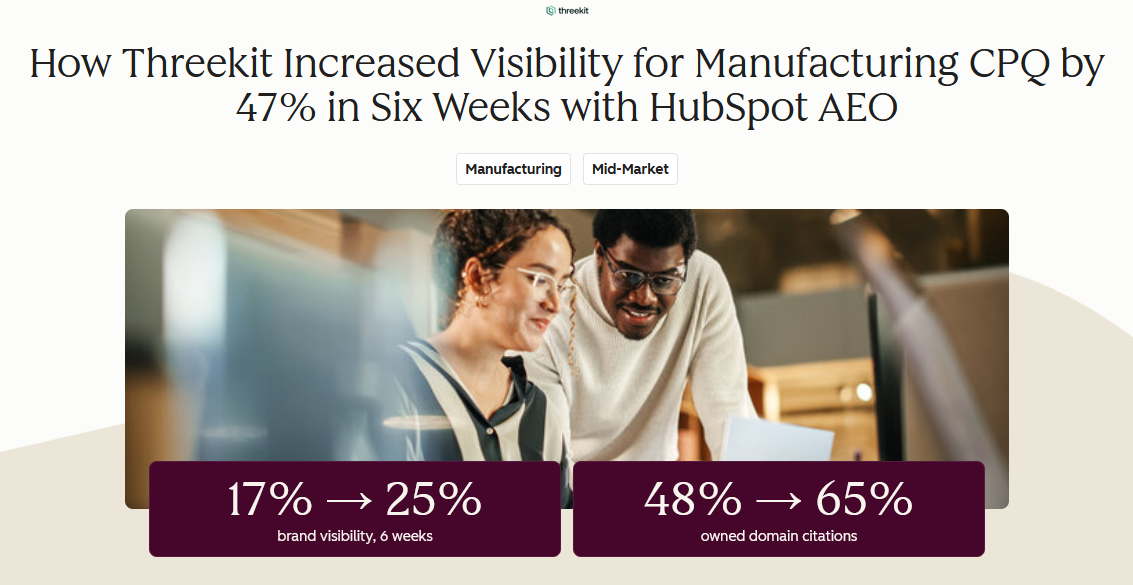
Image source: HubSpot
Final thoughts on writing a B2B case study
So that’s my view of how to write a B2B case study that actually wins you customers. A named customer, a problem to solve and tangible results, told as a story that keeps the customer the focus and leads with numbers. Get that right, and your case studies will bring you leads long after you’ve published them. The hard part, alongside getting the structure and planning right, is to find time to actually do it. I can help with that.
Writing B2B case studies is one of my favourite things to do. I’m Lucy, and I’m a freelance B2B case study writer. I’ve written high-conversion case studies for tech, SaaS, HR, payments and insurance companies. I handle the whole thing, from interviewing your customer (or working from a recording or transcript you already have), through to a finished case study that’s ready to publish.
If you’ve got a project that really deserves a case study (I’m sure you do!), fill in my discovery questionnaire and I’ll be in touch.
FAQs
How do you write a B2B case study that converts readers into customers?
Write it around your customer’s story. Open with a few standout results, then take the reader through the problem they faced, how your partnership solved it, what changed and a deeper exploration of the results at the end.
Keep the customer as the focus, avoid jargon and back claims up with direct customer quotes and statistics. The case studies that turn prospects into customers are specific, honest and easy for readers to see themselves in.
What do you include in a B2B case study?
Include a results summary, a short introduction to the customer, the problem they were facing, the solution you provided, the results and any expansion in the partnership. Include specific figures where possible, and integrate direct customer quotes.
How long should a B2B case study be?
Most B2B case studies are between 500 and 1,000 words, but they can be longer if the partnership was extensive. I’d say that structure matters much more than length, though.
How do you write a case study when you don’t have many numbers to include?
You can still write a strong case study without big headline numbers. Include whatever you can measure, like time saved, a smoother process or less stress for the team. [Insert number here] saved is great, of course, but it’s not everything. A specific quote about how things felt before and after has an impact, too.
Can you publish anonymous case studies?
Yes, you can publish anonymous case studies. Sometimes it’s the only way you can share what you do with the world. If you can’t name the customer, describe their sector and size instead, something like “a mid-sized UK payments company” and include results without giving away sensitive information.
Do case studies help with SEO?
Yes, case studies are great for SEO! They’re full of the language your buyers use to search for content on the problems they’re having, which helps you rank for long-tail terms your competitors might not have caught onto yet.
Where should you put case studies on your website?
I recommend creating a dedicated “case studies” or “customer stories” page. Make sure to link to them in blog posts as often as possible, too. Your case studies should feature heavily in your marketing and in sales conversations.
How do you get case studies to appear in AI search results?
Write your B2B case study so AI crawlers can easily lift answers. Give it a specific title like, “How [Company] reduced invoicing costs by 70%,” lead with the main results and include as much context and proof throughout the case study as possible.
Should you hire a B2B case study writer?
If you want to publish case studies, but can’t seem to find the time or need a little help from an expert, then yes, it’s a good idea to hire a case study writer. An experienced B2B case study writer will interview your customers (or use the meeting recording/transcript you have from when you interviewed your customer) and turn it into a story that turns customers into buyers. This is exactly what I do! I write B2B case studies for tech, SaaS, HR, payments and insurance companies.
How much does it cost to hire a B2B case study writer?
It varies, but the most experienced case study writers charge somewhere between £400 and £1,000 per case study. You can find out more about what B2B content writers charge in my article on the topic.
